How to Measure Whether Your Content Influences Buyers in AI Search
Here is a four-layer scorecard, with 12 signals, for measuring whether your content moves buying decisions inside AI answers.
Open ChatGPT and type the question your best customer asks right before they buy. Read the answer it gives back. Are you in it? Is your differentiation in it, or just your name sitting in a list next to three competitors? Could a buyer make a decision from what they just read, without ever opening your site?
Run that test for your top 20 buying questions and you will have a sharper read on your real market position than any rankings report has given you this year. Most teams have never run it. They are still reporting sessions and average position while the moment of influence has moved into answers they never see.
Quick answer: In AI search, content influence is no longer measurable by traffic alone. Score it across four layers instead. Presence (do you appear in the answer), Representation (does your positioning survive, or just your name), Persuasion (is the cited passage enough to move a decision without a click), and Conversion (when a click does happen, is intent higher). The middle two layers are where influence actually lives, and they are the two almost nobody measures.
The goal never changed. The route did.
Two years ago the path was clean. Your content ranked, the user clicked, they landed on your page, and the page did the persuading. Traffic worked as a proxy for influence because influence happened on property you owned and instrumented.
In AI search the click became a premium action. A meaningful share of buyers now form a shortlist inside an AI answer, visit two or three sources, and decide. The persuasion happens inside the answer, frequently before anyone reaches your domain. The goal is identical, which is to move a purchase decision. The place where it happens is not.
That single change breaks traffic as your headline metric. A page can lose 40 percent of its clicks and gain influence, because the model is now lifting your argument straight into the answer. Another page can hold its traffic and lose influence, because the model cites you for a generic fact and hands the buying logic to a competitor. Clicks no longer tell you which is which. You need to measure the answer itself.
The four layers of content influence
Influence is not one number. It is a sequence, and content can pass one stage and fail the next. Splitting it into layers tells you not just whether you are losing, but where.
1. Presence
Do you appear in the answer at all? If the model never surfaces you for a buying question, no influence is possible. This is the floor, and it is the easiest layer to measure because you can see it directly by running prompts.
2. Representation
When you do appear, does your positioning come through, or only your name? Models routinely extract a generic fact about you and discard the differentiation you spent years building. A brand can have strong presence and near-zero representation, mentioned everywhere and understood nowhere. This is the most common silent failure I see.
3. Persuasion
Is the passage the buyer reads enough to move them, even if they never click? Your proof, your comparisons, and your reasons to buy have to survive extraction into a few sentences. If the decision-driving content only exists in a hero image, a gated PDF, or a paragraph that does not stand on its own, it does not make it into the answer. This is where the influence in the headline of this post is won or lost.
4. Conversion
When a click does happen, is the intent higher? Clicks are rarer and more expensive now, so the ones that arrive should be warmer. If AI-referred visitors convert at the same rate as cold traffic, your answer presence is generating curiosity, not conviction.
The 12 signals, scored by layer
This is the scorecard I use. One row per signal. Score each as Strong, Mixed, Weak, or Not yet measured, and review it quarterly or per campaign.
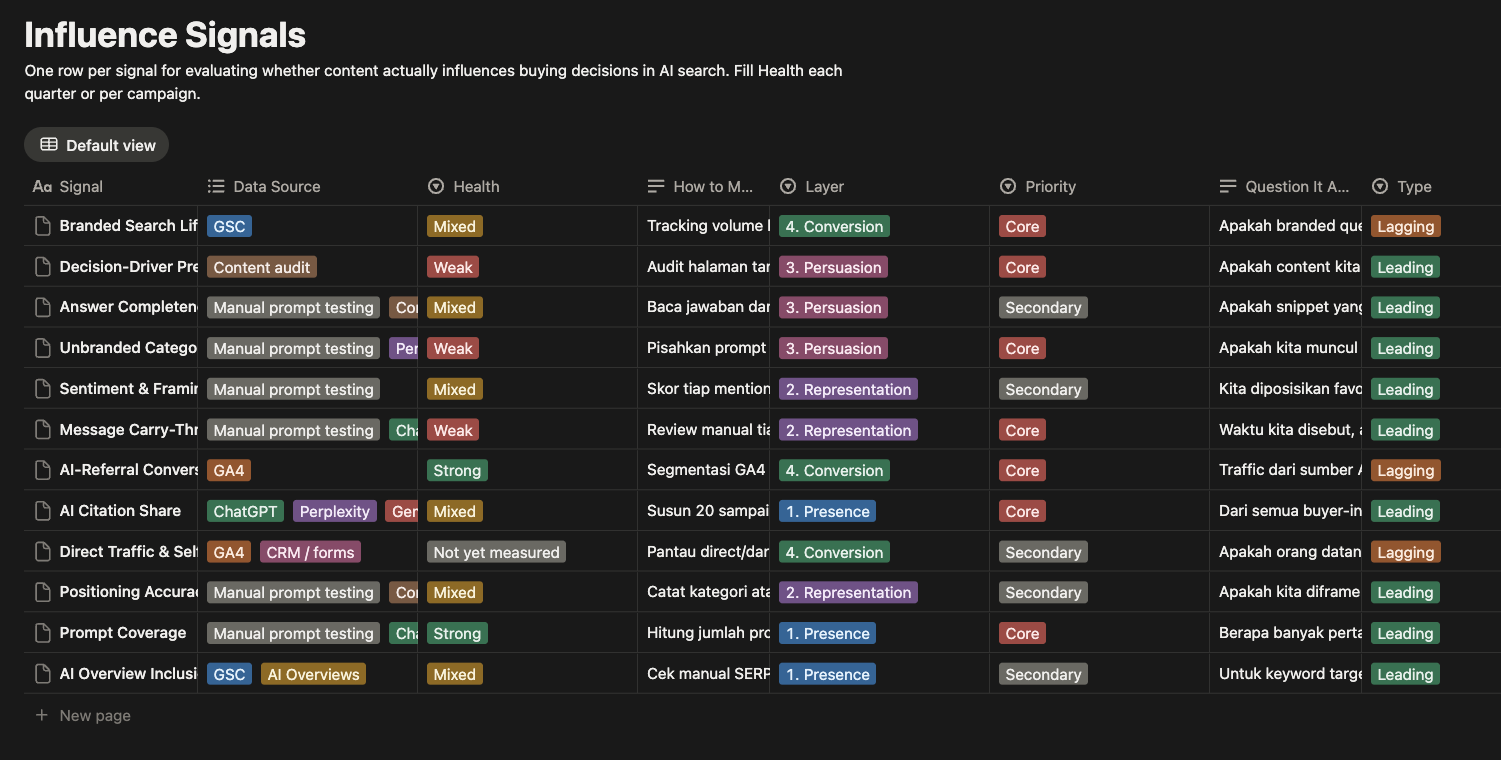
The live working version of this scorecard, the one I update as I learn, sits in a private Notion workspace. Open it, request access, and I will let you in.
Layer 1. Presence
- AI Citation Share. Of your target buying prompts, what share cite or mention you? Measure with prompt testing across ChatGPT, Perplexity, Gemini, and AI Overviews.
- Prompt Coverage. How many distinct buying questions surface you at all? Measure with prompt testing.
- AI Overview Inclusion. Do you appear in Google AI Overviews for target keywords? Measure with GSC and manual SERP checks.
Layer 2. Representation
- Message Carry-Through. When cited, does your key differentiator come through, or just your name? Measure with manual answer review.
- Positioning Accuracy. Are you framed in the right category and context? Measure with manual answer review.
- Sentiment and Framing. Are you positioned as a leader, a peer, or an also-ran? Measure with manual answer review.
Layer 3. Persuasion
- Decision-Driver Presence. Do your proof and comparisons survive extraction into a few sentences? Measure with a content audit.
- Unbranded Category Pull. Do you appear in non-branded prompts (best X, X vs Y, how to choose) where decisions form? Measure with prompt testing.
- Answer Completeness. Does the cited passage let the buyer decide, or push them to a competitor for the rest? Measure with manual answer review.
Layer 4. Conversion
- AI-Referral Conversion Rate. Does traffic from AI sources convert better than ordinary organic? Measure in GA4.
- Branded Search Lift. Do branded queries rise after your AI presence grows? Measure in GSC.
- Direct and Self-Reported Attribution. Do buyers arrive direct or tell you they found you through AI? Measure in GA4, CRM, and intake forms.
How to run it
You do not need a new platform to start. You need a disciplined prompt set and a willingness to read answers like a buyer.
Build a list of 20 to 50 prompts that mirror how your customers actually ask, weighted toward the unbranded, decision-stage questions where shortlists form. Run them across the assistants your market uses. For the Presence and Conversion layers, the numbers come from your prompt log, GSC, and GA4. For Representation and Persuasion, you read each answer and judge it, because no dashboard can yet tell you whether your differentiation made it through intact. That reading is the work, and it is also the part that gives you an edge, because almost no one does it.
Where most brands leak
When I score this for the first time with a client, the pattern is almost always the same shape. Presence is decent, because solid SEO already earned the entity signals that get them mentioned. Conversion looks fine, because the thin trickle of AI traffic that does click is warm. And the middle caves in. Representation and Persuasion come back Weak.
That is the diagnosis that matters. It means the brand shows up in the answer and then gets stripped to a name, while a competitor supplies the reasoning the buyer uses to decide. The content is present but not persuasive. It is along for the ride in someone else's pitch.
Fixing it is not a presence problem, so more rankings will not solve it. It is a content architecture problem. The differentiation has to be written in passages that stand alone, the proof has to be in extractable text rather than locked in design, and the comparisons buyers want have to exist on your pages instead of only in your sales calls. You write for the chunk that gets lifted, not the page that gets visited.
The shift in one line
Stop asking how to rank first. Start asking whether the answer a buyer reads, without ever reaching your site, is enough to make them choose you. If it is not, that gap is the most valuable work on your roadmap.
Ridho Putradi S'Gara is an AI Search Consultant working at the intersection of SEO, AEO, and GEO. He writes about measuring and engineering brand influence across AI answer engines.